Picking the wrong sofa is an expensive mistake.
You spend hours browsing, finally bring it home, and it either swamps the room, breaks down within two years, or looks nothing like it did in the showroom.
The good news is that choosing the right sofa set comes down to a few clear decisions around layout, size, fabric, and build quality. Get those right, and your living room works beautifully for years.
Sectional or Sofa Set: Which Layout Actually Works for Your Room?
Your room shape decides this more than personal taste does. Both options have real strengths, and picking the wrong one makes even a gorgeous sofa feel awkward.
In open-plan spaces, an L-shaped or U-shaped sectional acts as a natural room divider.
It separates the living area from the dining space without walls or blocking light. For compact open-plan rooms, aim for a total sectional length between 240–280 cm to keep the floor plan breathing.
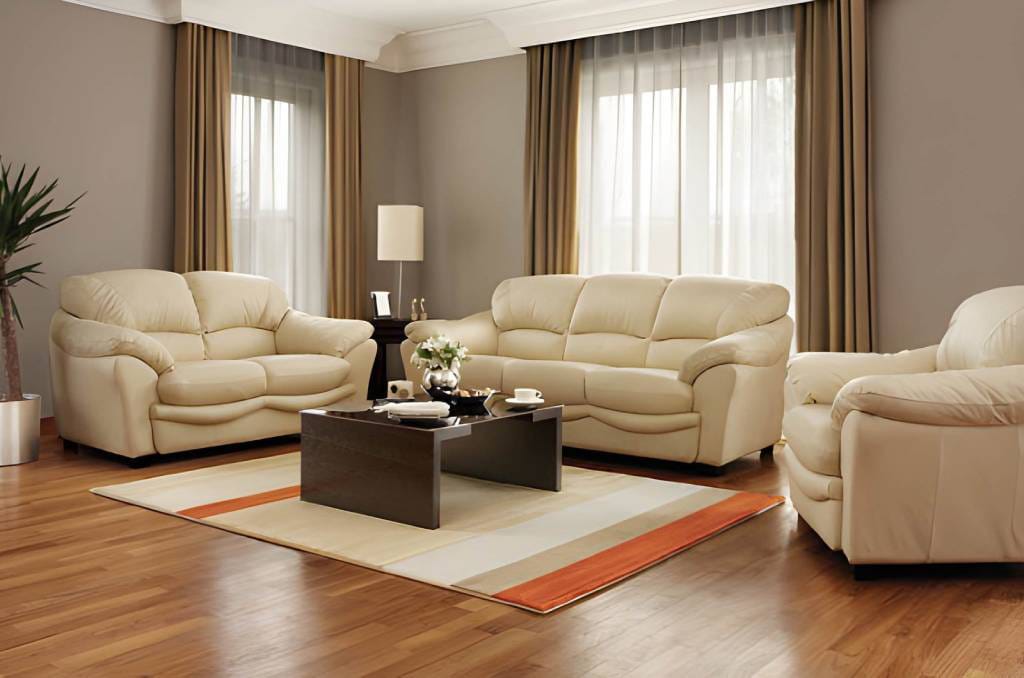
In square or traditional rooms, a 3-seater paired with a 2-seater creates a natural conversation triangle around a central coffee table.
This setup scales well for rooms between 20–30 m² and is easy to expand later with an armchair or ottoman. For small rooms under 20 m², a compact 2-seater plus an accent chair or a small L-sectional around 200–240 cm works best.
How to Measure Your Room Before You Buy
Even the most stylish sofa becomes a problem if it doesn’t fit or worse, can’t get through the door. Measure everything before you commit.
A simple rule: your sofa’s floor footprint should not exceed 30% of the total room area. In a typical 30 m² living room, a standard 3-seater around 2–2.5 m wide fits comfortably within that limit and still leaves room for rugs, side tables, and walkways.
Standard 3-seater sofas run 180–240 cm wide, 90–110 cm deep, and around 80–90 cm tall.
A 2-seater typically sits between 130–180 cm wide. Before ordering, measure your doorway, hallway turns, and elevator dimensions too.
Many sectionals are delivered in modules for exactly this reason, so check whether your chosen brand offers assembly-in-situ options if you live in an apartment.
The Right Fabric Makes or Breaks Your Sofa’s Lifespan
How your sofa looks in five years depends entirely on what it’s made of today. Fabric durability is measured using the Martindale abrasion scale, and for a family living room, you want at least 30,000–50,000 Martindale on high-traffic seating.
| Fabric Type | Martindale Rating | Pet-Friendly | Maintenance |
| Woven polyester / microfiber | 30,000–100,000 | High | Low (wipeable) |
| Performance velvet (poly) | 50,000+ | Medium–High | Medium |
| Wool-nylon blend | 40,000–70,000 | Medium | Medium–High |
| Linen / linen-poly blend | 30,000–40,000 | Medium | Medium |
| Cotton velvet (natural) | 20,000–40,000 | Low–Medium | High |
For most households, woven polyester or performance microfiber hits the best balance of toughness and easy cleaning.
Fabrics under 25,000 Martindale belong in formal or low-use rooms, not everyday family seating.
On the sustainability side, many brands now use recycled polyester made from plastic bottles. It can last up to 12 years in high-use environments and cuts resource consumption significantly compared to virgin fibers.
What’s Actually Inside Determines How Comfortable It Is
The cushion filling and frame construction are what you’re really paying for. A sofa can look perfect and feel terrible within a year if the internals are cheap.
High-resilience (HR) foam is the most practical choice for daily use.
It supports your body firmly and springs back after each use without losing shape. Down-feather blends feel more luxurious but need regular plumping and wear out faster. If you want the best of both, look for sofas with pocket springs in the seat base; they add support and reduce sagging over time, especially in deeper lounge-style designs.
For the frame, kiln-dried hardwood is the benchmark.
It has low moisture content, which prevents warping or twisting over the years of use. Cheaper frames made from MDF or softwood weaken under regular heavy use.
On seat depth, 60–65 cm with HR foam cushions delivers the most balanced everyday comfort, deep enough to relax, not so deep that it dominates a smaller room.
Smart Features Worth Paying For in 2026
Modern sofas have caught up with how people actually live.
Many 2026 models now include USB-C ports and wireless charging pads built into armrests or console-style bases. USB-C is the better choice over USB-A for future-proofing across devices.
Modular designs take flexibility further with removable chaise units, movable headrests, and hidden storage ottomans for blankets or remotes. One often-overlooked feature is leg height.
Most robot vacuums need around 10 cm of clearance to clean underneath. Choosing a sofa with 10–15 cm legs and an open base keeps your floor genuinely clean without lifting cushions manually.
Mistakes That Catch Most Buyers Off Guard
Buying without taking fabric swatches home is one of the most common regrets.
Showroom lighting is designed to flatter. Natural daylight, your wall colors, and the direction of sunlight in your home will change how a fabric looks entirely. Test swatches throughout the day before deciding.
Another mistake is skipping the “right to repair” check.
Many quality sofas now offer removable, washable covers and replaceable cushions. This extends the sofa’s life and saves you from a full replacement when one cushion wears out. Always confirm whether covers come off and whether cushions can be replaced individually before you buy.
The Bottom Line
A great sofa isn’t just about looks.
It’s about choosing the right layout for your room shape, confirming it fits before delivery, selecting a fabric with enough durability for how you actually live, and checking what’s inside the frame and cushions.
In 2026, organic textures, warm neutrals, and modular designs lead the market, but none of that matters if the sofa falls apart in three years. Buy smart, and you won’t have to buy again.