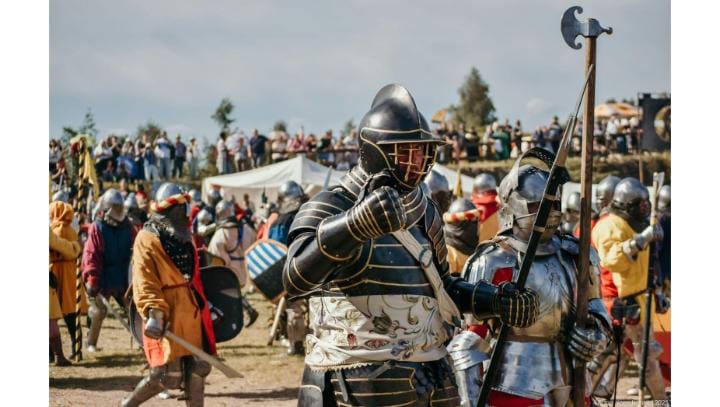
The buhurt axe holds its own distinctive and uncomfortable status among all weapons approved for use in modern buhurt. The weapon features basic operational mechanics which create a harsh visual appearance that requires excessive effort from any fighter who selects it.
Axes operate through their compact striking head which connects to a lever system that channels power into a precise impact point while swords distribute their weight throughout the blade and shields provide protection through their outer structure.
The axe collection of Medieval Extreme demonstrates this particular fact. These objects function as actual weapons which can withstand multiple strikes against steel armor and shields and human targets during BI and IMCF combat.
The professionalization of buhurt and the advancement of injury tracking systems during 2026 will lead to a new understanding of axes which now function as sophisticated combat systems that require advanced skills and special training because they employ defensive technology.
Historical role of axes in medieval warfare
The mechanical efficiency of axes led to their adoption as weapons on medieval battlefields. Axes generate concentrated impact through their rotational momentum while swords depend on their edge alignment and cutting velocity. Viking Age through late Middle Ages archaeological and written evidence shows infantry used axes to combat armored opponents through their effective use against mail and helmets and shields.
The High Middle Ages saw the development of specialized axe forms which included the Danish axe and the pollaxe. These weapons were not crude; they were purpose-built tools for armored contexts, which had hammer faces and spikes and reinforced beaks that transmitted force through armor instead of slicing it. The frequency of soldiers using axes increases during times when soldiers wear more armor because their weapons become less effective against their enemies.
Judicial duels and battlefield formations adopted axes as their standard weapon by the 14th and 15th centuries. The requirements for using them included spatial awareness and timing ability and physical endurance which matched the needs for modern buhurt combat. The historical lesson shows that warriors selected axes because they provided effective combat solutions against armored opponents who rendered other weapons less useful.
Why axes are feared in modern buhurt
The same physics principles from the past continue to operate in modern buhurt practices. An axe strike delivers higher peak impulse than a sword of similar mass because more weight is concentrated at the end of the lever. Sports biomechanics research on striking implements shows that distal mass concentration increases impact force but also increases joint load and recovery time.
The one-handed axe from Medieval Extreme, which weighs approximately 1.1 kg, delivers more localized force than most one-handed swords due to its design. The energy transfer in long axes such as the Long Axe Amnesia and Long Axe Justice, which weigh approximately 2.2 to 2.3 kilograms, becomes crucial during mass battles that involve shield lines and clinching techniques.
| Aspect | Axe | Sword |
| Mass distribution | Concentrated in head | Distributed along blade |
| Impact impulse | Higher peak force | Lower, more distributed |
| Recovery speed | Slower | Faster |
| Joint stress | Higher (shoulder, elbow) | Lower, more continuous |
| Tactical role | Armor disruption, control | Tempo, scoring volume |
The catalog of Medieval Extreme displays a complete range of weaponry which includes fast one-handed weapons and heavy two-handed weapons used in large-scale warfare. The heavier models serve specific functions because they act as specialized equipment which operates in particular roles.
Training requirements for axe fighters
Axe selection leads a fighter to develop different training methods. The fighter needs to focus more on their conditioning and technical skills instead of developing sheer strength. Research studies from combat sports and historical fencing demonstrations show that rotational weapons cause higher eccentric loading on the shoulder girdle and lower back. The body develops overuse injuries when people exercise without proper preparation.
Effective axe training focuses on:
- Rotational core strength and deceleration control
- Grip endurance under shock loading
- Timing drills to reduce over-commitment
- Clinch recovery and weapon retention
- Controlled striking against armor, not air
The Long Axe Amnesia and Long Axe with Hammerhead require athletes to possess advanced skills because their weight demands higher physical and tactical combat abilities in 5v5 and bigger battles.
Axe fighters need to develop their defensive skills through dedicated training. Axes do not support fast parrying movements, which creates a major difference between them and swords. The team needs to rely on footwork and distance management together with their team coordination abilities to make up for this restriction.
Risk management and protection
Modern buhurt mitigates this through equipment integration. Axe fighters need to use reinforced gauntlets and rigid elbow cops and proper forearm coverage as essential equipment. Helmets and gorgets must handle not just cuts, but blunt rotational impacts. Shields, when used with one-handed axes, act less as passive defense and more as force dampers.
The axe designs of Medieval Extreme demonstrate how safety regulations require specific design features. Choose deliberately, train accordingly, and build your protection system around the forces you plan to generate.