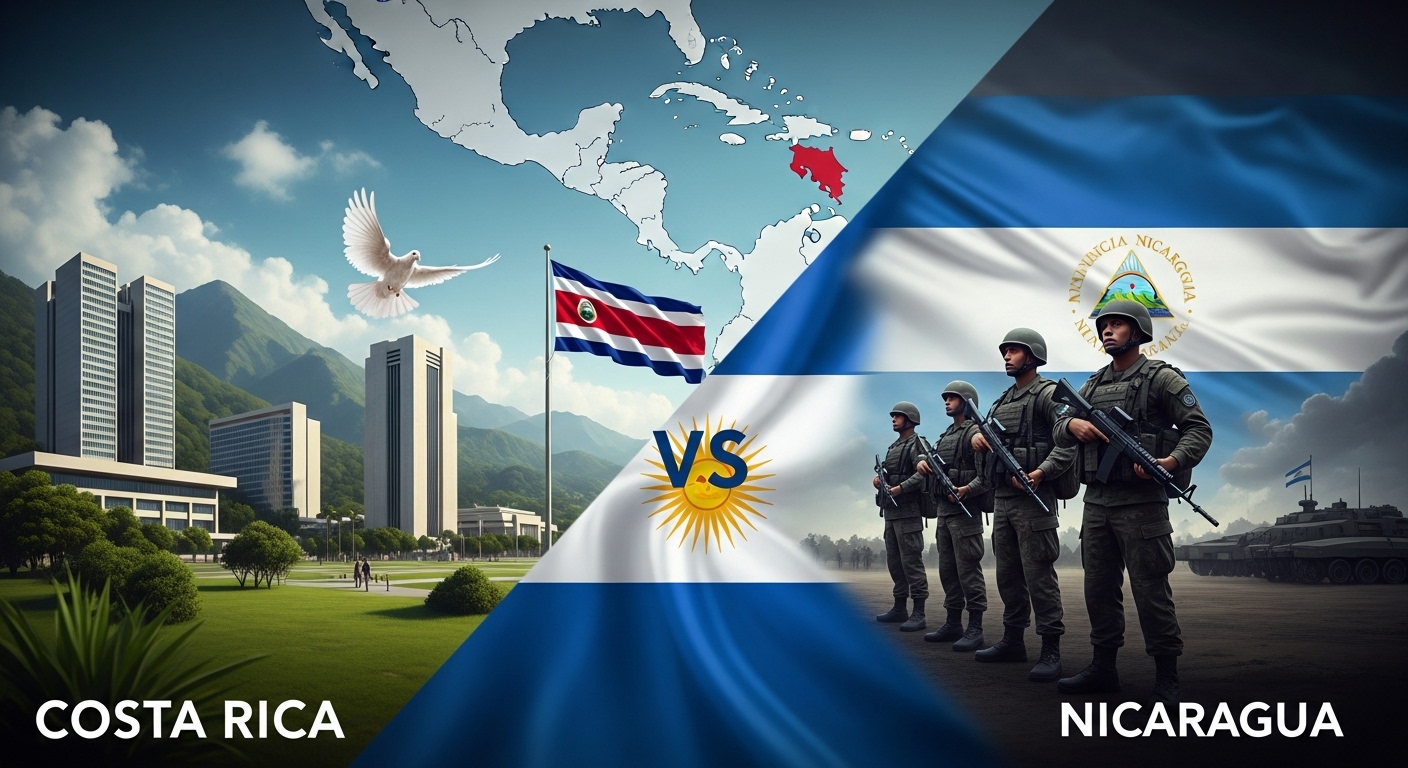
Central America is often seen as a unified region, but a closer look reveals deep contradictions between neighboring states. The comparison between Costa Rica Vs Nicaragua provides a clear example of how political philosophy, military policy and regional strategy can shape national identity. Despite sharing borders, history and cultural roots, the two countries have chosen completely different paths in terms of defence, governance and international influence. These differences are not only symbolic but also deeply practical, affecting diplomacy, economic development and regional stability.
Understanding Costa Rica Vs Nicaragua is essential for anyone studying Central American geopolitics, regional security, or international neutrality. One nation abolished its army and adopted peace as state policy, while the other maintained a strong military presence closely linked to political power. This divergence has shaped how each country is viewed and how they interact with neighbors and global institutions.
Historical Roots of Divergence
The roots of the Costa Rica Vs Nicaragua divide stretch back to the 19th and 20th centuries, when political instability plagued much of Central America. Nicaragua experienced a long period of dictatorship, revolution and armed conflict, which established the military as the central pillar of state authority. The armed conflict was deeply woven into national politics, affecting leadership structures and governance.
Costa Rica followed a dramatically different trajectory after the civil war of 1948. Instead of strengthening its armed forces, the country completely disbanded the military and redirected resources towards education, health care and democratic institutions. This decision redefined the country’s identity and laid the foundation for a neutral foreign policy, a concept that still guides Costa Rican diplomacy today.
Costa Rica’s Military Abolition and Neutrality Doctrine
One of the most important features in the comparison between Costa Rica Vs Nicaragua is the complete lack of a standing army in Costa Rica. Instead of conventional armed forces, Costa Rica relies on civilian police units and international law for security. This model is often cited globally as an example of how security can be achieved without militarisation.
Costa Rica’s neutrality is not passive; It is proactive and diplomatic. The country invests heavily in international courts, multilateral organizations and conflict mediation. This approach has allowed Costa Rica to become a moral authority in the region, strengthening its regional influence in Central America despite having no military power. Neutrality has also promoted political stability and economic development by reducing internal conflicts and military spending.
Nicaragua’s Military Structure and Political Role
In contrast, Nicaragua maintains a formal and active military institution that plays an important role in national politics. Within the Costa Rica Vs Nicaragua framework, Nicaragua’s armed forces are not only a defense mechanism, but also a symbol of sovereignty and state control. The military has historically been involved in political change and internal security operations.
Nicaragua’s leadership considers military force necessary to maintain national unity and prevent external pressure. This approach is consistent with broader strategies of centralized power and strict governance. While this has brought stability to the regime, it has also contributed to international criticism and strained diplomatic relations, particularly with regard to human rights and democratic standards.
Defense Spending and National Priorities
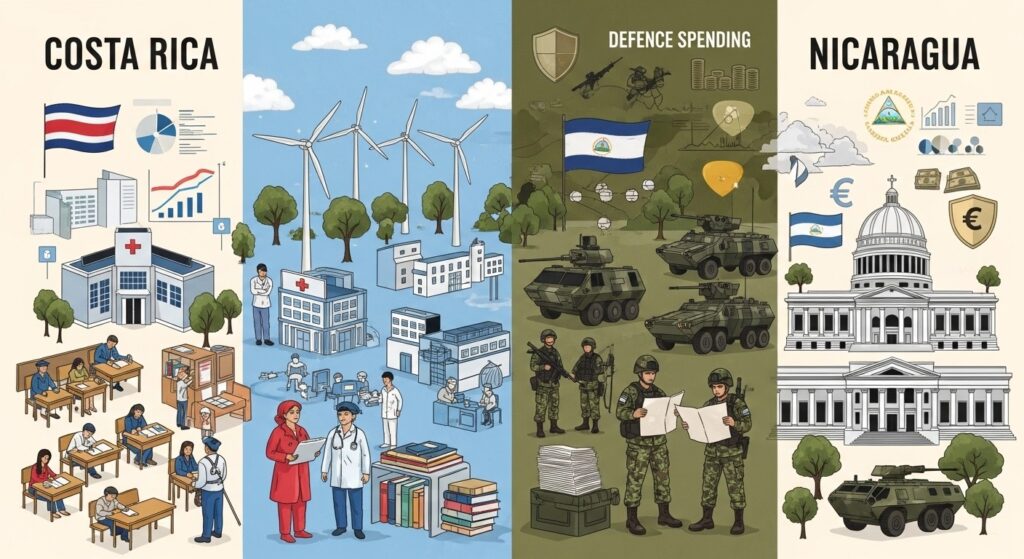
Defense budgets reveal a lot about national priorities, and the difference between Costa Rica Vs Nicaragua is striking. Costa Rica allocates its financial resources to social development, education, environmental protection and public health. This redistribution has helped the country achieve international recognition for high literacy rates, strong health outcomes and sustainability.
On the other hand, Nicaragua continues to invest in military infrastructure and internal security. These expenditures reflect concerns over sovereignty, internal dissent and regional balance of power. While defense spending has ensured control and deterrence, it has limited funding for social programs, hindering long-term growth and economic resilience.
Regional Security Dynamics
When analyzing Costa Rica Vs Nicaragua, regional security becomes a central theme. The lack of a military in Costa Rica has not led to insecurity; Instead, it has relied on international alliances, legal frameworks and diplomatic engagement. This strategy has enabled the country to resolve disputes through courts rather than through conflict.
Nicaragua’s military position positions it as a traditional security actor in Central America. It emphasizes border control, internal stability and deterrence. This difference creates a unique dynamic in which one nation promotes peace through diplomacy, while the other asserts authority through military preparedness, shaping the broader Central American geopolitical landscape.
Border Issues and Diplomatic Relations
Border conflicts have tested the contrasting approaches of Costa Rica Vs Nicaragua. Relations remain strained from time to time due to disagreements over river boundaries and migration issues. To reinforce its commitment to peaceful conflict resolution, Costa Rica has consistently pursued legal solutions through international courts.
Nicaragua has adopted a more assertive stance, sometimes framing disputes in nationalist and security-oriented terms. These different responses highlight how military capability affects diplomatic tone. Costa Rica’s approach has strengthened the country’s international reputation, while Nicaragua’s stance has reinforced its image as a state that prioritizes sovereignty and control.
International Perception and Soft Power
Soft power plays a big role in the comparison between Costa Rica Vs Nicaragua. Costa Rica is considered a peaceful, democratic and environmentally responsible nation. Its commitment to neutrality and human development enhances its global standing and attracts tourism, investment and diplomatic goodwill.
International perception of Nicaragua is more complex. Although it emphasizes independence and resistance to outside influence, concerns about governance and militarization have limited its soft power. This paradox illustrates how military choices can shape not only security, but also a country’s global image and economic opportunities.
Economic Impact of Military Choices
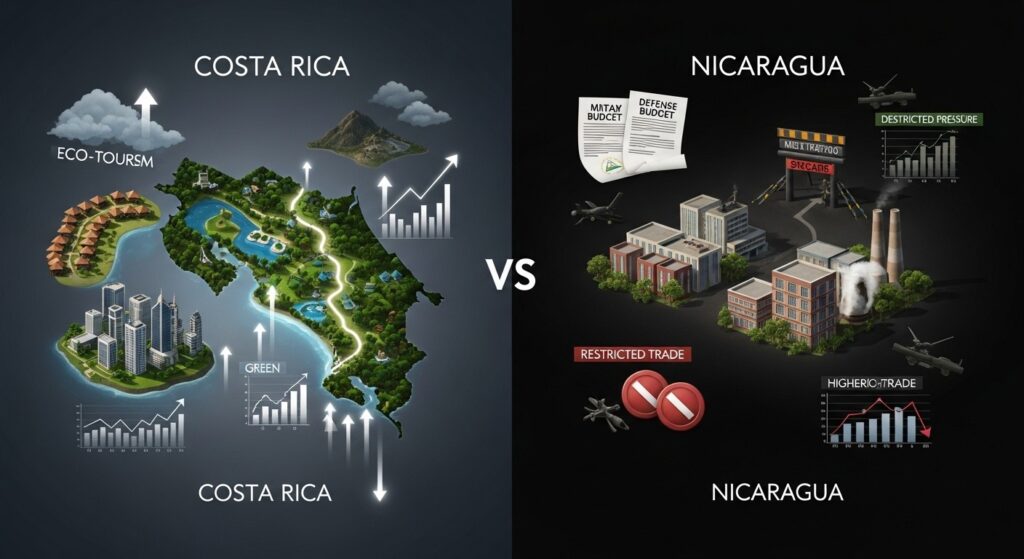
The economic consequences further illustrate the long-term effects of the Costa Rica Vs Nicaragua strategies. Costa Rica’s decision to end its military frees up resources for innovation and infrastructure. Over time, this has contributed to a diversified economy driven by tourism, technology and sustainable development.
Nicaragua’s economy remains more constrained, in part due to political instability and military-centric rule. While the armed forces provide internal security, economic growth has been slow and international sanctions have affected trade and investment. These economic realities underlie how defense policy affects national prosperity.
Role in Regional Mediation and Influence
Costa Rica’s neutrality has positioned it as a mediator in regional conflicts, increasing its regional influence in Central America. The country often acts as a neutral base for negotiations, leveraging its peaceful reputation to facilitate cooperation between neighboring states.
Nicaragua’s influence is more vocal and ideological. It is aligned with specific regional factions and emphasizes sovereignty and resistance to external pressure. In the Costa Rica Vs Nicaragua comparison, this results in two very different models of influence: one based on diplomacy and trust, the other on power and political alignment.
Comparative Overview Table
| Aspect | Costa Rica | Nicaragua |
| Military Status | No standing army | Active armed forces |
| National Strategy | Neutrality and diplomacy | Security and sovereignty |
| Defense Spending | Minimal | Significant |
| International Image | Peaceful and democratic | Assertive and controlled |
| Regional Role | Mediator and neutral actor | Traditional security state |
Future Outlook and Strategic Implications
Looking ahead, the contrast between Costa Rica Vs Nicaragua will continue to shape the future of Central America. Costa Rica’s model shows that peace, neutrality and social investment can provide long-term stability and impact. Its approach challenges traditional assumptions about security and power.
Nicaragua’s path reflects the belief that military power ensures sovereignty and political continuity. Although effective at maintaining control, it faces increasing pressure to balance security with economic and social development. As Central America adapts to global changes, the evolving regional environment will test both strategies.
Conclusion
The comparison between Costa Rica Vs Nicaragua reveals not only political differences; This highlights two competing visions of the state. One prioritizes peace, diplomacy and human development, while the other emphasizes military strength and centralized authority. Both approaches have deeply shaped national identity and regional influence.
Ultimately, Costa Rica Vs Nicaragua serves as a case study in how military politics and neutrality can redefine power in modern geopolitics. Their contrasting paths provide valuable lessons for small states in dealing with regional challenges, proving that influence does not always come from force, but sometimes from principled restraint and strategic diplomacy.