
Clarity and efficiency are essential in professional writing. Long organizational names, technical terms and repetitive references can reduce the reader’s understanding. To solve this, authors often use abbreviations. Of these, association abbreviations play an important role in legal, medical and business documents. They condense complex phrases into manageable shorthand, streamlining communication without compromising meaning. Correct use of these abbreviations supports document clarity, reduces redundancies and maintains a professional tone.
However, using incorrect or inconsistent abbreviations can confuse readers and undermine credibility. This makes it important for writers to understand how to create and use association abbreviations appropriately in various business contexts.
Legal Documents: Streamlining Complex Terminology
Legal documents are notorious for their long, technical terms. The names of associations, councils and regulatory bodies are often long names that appear repeatedly in contracts, agreements or legal proceedings. Here association abbreviations provide a practical solution.
For example, “American Bar Association” is often abbreviated to ABA. By introducing abbreviations after the first full mention, the author ensures that the reader can follow longer phrases without repetition. Consistency and adherence to recognized abbreviations are essential, reflecting professional standards in the legal field. Misuse or creation of ad hoc abbreviations can lead to misinterpretation or even legal disputes.
Medical Documents: Precision and Efficiency in Healthcare
In medical writing, documents often refer to trade unions, research councils and regulatory organisations. Association abbreviations such as AMA (American Medical Association) or CDC (Centers for Disease Control and Prevention) are standard tools to save space and maintain readability.
Medical professionals rely on these abbreviations for quick understanding, especially in research articles, patient records, and policy documents. The introduction of abbreviations supports consistent document clarity and ensures that information remains accessible across multidisciplinary teams. Incorrect abbreviation formation in medical writing can lead to serious miscommunication, highlighting the important role of correct abbreviation practice.
Business Documents: Enhancing Communication and Professionalism
Business writing also often uses association abbreviations for chambers of commerce, trade organizations and works councils. For example, “International Chamber of Commerce” becomes ICC, and “World Business Council for Sustainable Development” is shortened to WBCSD.
Correct use of these abbreviations reflects professional standards and demonstrates knowledge of industry norms. In business reports, presentations and correspondence, consistent use of abbreviations improves readability and strengthens credibility. Random or inconsistent abbreviations can confuse customers, stakeholders or regulatory authorities, making a structured formation necessary.
Rules for Forming Association Abbreviations
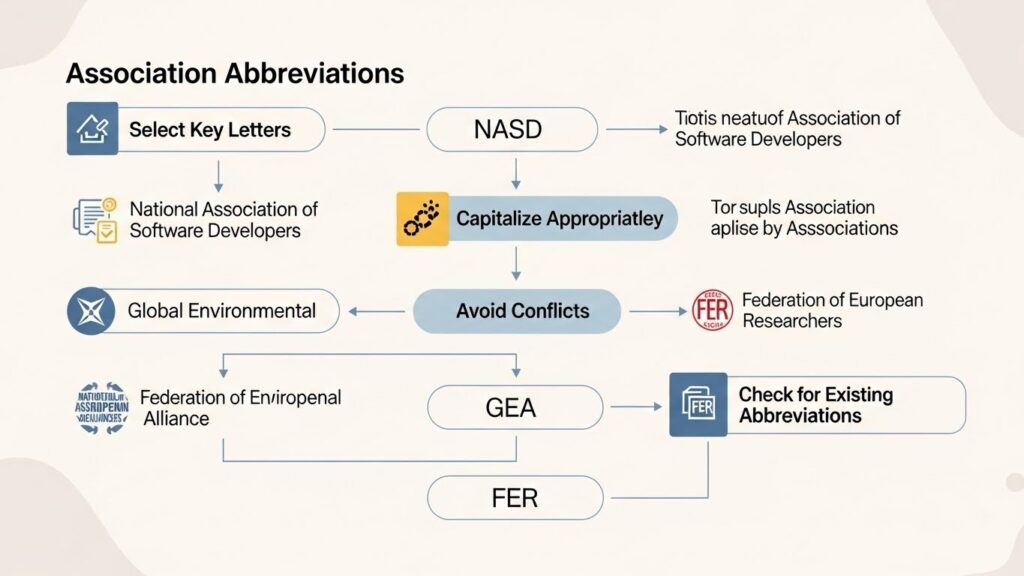
The formation of association abbreviations follows systematic rules. Writers usually choose the first letters of keywords, ignoring articles and prepositions. Capital letters are standard to distinguish abbreviations from regular words. To maintain transparency, the full name of the association should be mentioned first followed by the abbreviation in brackets.
Helpful practices include checking for conflicts with existing abbreviations, avoiding overly complex combinations, and ensuring that the abbreviation is pronounceable and memorable. These strategies ensure document clarity, strengthen professional standards, and strengthen consistency in industry terminology across disciplines.
Common Association Abbreviations Across Fields
| Full Name | Field | Abbreviation | Usage Context |
| American Bar Association | Legal | ABA | Contracts, court documents |
| Centers for Disease Control and Prevention | Medical | CDC | Research papers, health policy documents |
| American Medical Association | Medical | AMA | Research articles, policy briefs |
| International Chamber of Commerce | Business | ICC | Corporate reports, trade documentation |
| World Business Council for Sustainable Development | Business | WBCSD | Sustainability reports, corporate strategy |
This table highlights how structured abbreviation formation simplifies professional writing across multiple disciplines while preserving clarity and accuracy.
Best Practices for Introducing Abbreviations
Introducing association abbreviations requires effective timing. The abbreviation should follow the first full mention of the organization and ensure that readers can refer to it throughout the document. Overuse of abbreviations should be avoided, especially when communicating with audiences unfamiliar with the terminology.
Business documents benefit from following a style guide or organizational manual that outlines acceptable abbreviations. This ensures consistency, increases document clarity and maintains professional standards. A clear introduction also supports the long-term usefulness of documents across departments and interdisciplinary teams.
Challenges and Pitfalls
Authors often face challenges when using association abbreviations. A common mistake is to create ambiguous abbreviations that conflict with other established terms. Another danger is inconsistent use, where the abbreviation is replaced by the whole word without reason, which hinders readability.
In highly technical fields, excessive use of abbreviations can overwhelm readers, especially if they are unfamiliar with specific industry terminology. So it’s important to balance brevity with clarity to maintain professionalism and readability.
The Role of Style Guide
Many legal, medical, and business organizations provide style guides that standardize association abbreviations. These guides specify capitalization rules, initial explanations and acceptable abbreviation lists. Following such guidelines ensures uniformity across documents and departments.
Adherence to these rules raises professional standards, promotes consistent use, and reduces misinterpretation. Style guides also support collaborative work by ensuring that team members have a unified approach to the use of abbreviations.
Technological Tools and Automation
Modern writing software and document management systems often include abbreviation checkers, which can detect inconsistencies or conflicts in the use of abbreviations. These tools help authors maintain document clarity and maintain professional standards, especially in longer documents or those that require regulatory compliance.
Automated tools also help create tables of abbreviations for reference, which is particularly useful in medical or business reports where multiple associations are cited. These technologies complement traditional best practices and streamline the writing process.
Conclusion
Understanding and using association abbreviations correctly is essential for legal, medical and business writers. Proper formatting, consistent application, and adherence to style guides improve readability, support document clarity, and maintain professional standards.
By carefully incorporating these abbreviations, authors can simplify complex terminology, strengthen communication, and ensure that their documents meet the expectations of their professional audience. Proper use of association abbreviations ultimately bridges the gap between technical accuracy and reader comprehension, making it an essential skill in professional writing.